
Tree Trimming and Removal in Cutler Bay, FL
- Home
- Tree Service
- Tree Trimming and Removal

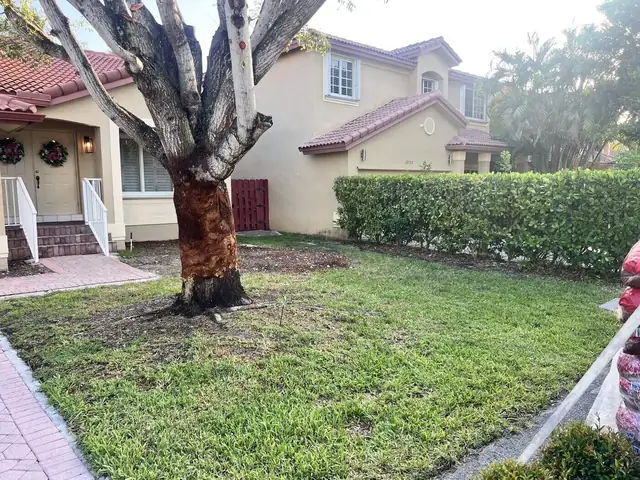
Most people calling about a tree have the same question: can this be saved, or does it have to come down? Lovescape assesses the tree first and gives you an honest answer. When trimming is enough, we trim it properly, without topping. When removal is safer, we take it down carefully and haul everything away.
Trim it or take it down? How we decide
| What you notice | What it usually means |
|---|---|
| Dead branches in an otherwise full canopy | Trimming. Removing dead wood is routine and keeps the tree healthy. |
| Limbs over the roof, pool, fence or power line | Trimming to clear them, or removal of a single weak limb. |
| Heavy lean toward the house, or the lean has changed since the last storm | Often removal. Have it assessed soon. |
| Cracks in the trunk, large dead sections, fungus growing at the base | Likely removal. These are signs of decay inside. |
| Soil lifting or cracking around the roots | The root system may be failing. Get it looked at. |
We start every job with an assessment of the tree’s health and risk. If a tree can be kept, we will tell you so, because a tree that is properly trimmed is worth more than an empty spot where one used to be.
Proper trimming: what we cut and what we leave
Good trimming makes a tree stronger. Bad trimming shortens its life. Miami-Dade County treats pruning done to the American National Standards Institute A-300 standard as proper, and says plainly that topping and hat-racking, which means cutting a tree back to stubs, are improper and can violate the County code. The Town of Cutler Bay adds a practical limit: no more than 25 percent of a tree’s canopy should be removed.
- We trim for shape, health and storm safety, removing dead, crossing and weak branches.
- We thin the canopy so wind can pass through it, instead of cutting the top off.
- We keep branches clear of roofs, and clear of streets and sidewalks. Cutler Bay expects 13 feet of clearance above streets and 8 feet above sidewalks.
Palms are different
A palm grows from a single point at the top, so you cannot prune it the way you prune an oak. University of Florida extension guidance is that palms generally need only dead fronds, flower stalks and heavy fruit removed. Shaving a palm down to a small tuft, sometimes called a “hurricane cut,” does not protect it in a storm, and it robs the palm of the green fronds it lives on. UF/IFAS Miami-Dade states that palms do not need hurricane pruning at all.
If you have been told your palm needs a hurricane cut, get a second opinion.
Taking a tree down safely near a house, pool or fence
Most removals in a Cutler Bay yard are not open-field jobs. They are trees close to a roof, a screen enclosure, a pool, a shared fence or a power line. Large sections have to be cut and lowered, not dropped. Before you hire any tree company, ask how they will protect your roof, fence and pool, and expect a specific answer.
If a tree is near power lines, do not touch it yourself. FPL can be reached at 1-800-468-8243.
Do you need a permit to remove a tree?
In Miami-Dade, a permit is required to remove or relocate any tree that is not specifically exempt under the County code. Proper pruning does not need one. Whether your tree needs a permit depends on the tree and the property, and the approval process takes about 21 days, so it is worth checking before the crew is scheduled. The County Tree Program handles questions at 305-372-6574, and the Town of Cutler Bay sends tree removal permits to Miami-Dade County.
When you ask for an estimate on a removal, we tell you whether it is likely to need a permit, so there are no surprises on the day. Please confirm with the County before any large tree is removed.
Want the full rules? Read our guide: do you need a permit to remove a tree in Miami-Dade?
How a tree job works
Free estimate
We walk the property, look at the tree and what is around it, and give you a price with no obligation.
Scheduled work
We schedule the job at a time that works for you. A licensed, insured crew does the work.
Cleanup and walkthrough
Wood and debris are hauled away, and we walk the finished job with you before we call it done.
What changes the price of a tree job
- Height and trunk diameter. A 30-foot tree and a 60-foot tree are very different jobs.
- What is under or beside it: roofs, pools, screen enclosures, fences and wires add time and care.
- Access. A tree in a fenced backyard that equipment cannot reach takes longer than one at the curb.
- Whether you want the stump ground as well. Ask for stump grinding in the same estimate and the whole thing is priced together.
- Cleanup. Wood and debris hauled away is included in our scope.
What Cutler Bay Homeowners Say
Tree work around Cutler Bay and Palmetto Bay
Hurricane Andrew crossed this area in 1992, and many homeowners here pay close attention to the trees around their house. Along Old Cutler Road, many yards sit under mature banyan and strangler fig canopy, where the work is as much about roots and thinning as it is about cutting back. Closer to Biscayne Bay and Black Point Park & Marina, wind and salt are harder on trees, and storm-damaged limbs are more common. We work throughout Cutler Bay, Palmetto Bay, Pinecrest and Kendall.
Tree Trimming and Removal Questions
Extensive dead wood, trunk or root damage, a heavy lean toward a structure, cracks, or fungus at the base usually mean removal is safer than trimming. We assess the tree and give you an honest recommendation.
A permit is required to remove or relocate any tree that is not specifically exempt under the County code, and approval takes about 21 days. Proper pruning does not need a permit. Call the County Tree Program at 305-372-6574 before removing a large tree.
The Town of Cutler Bay says no more than 25 percent of the existing canopy should be removed. Topping and hat-racking are prohibited.
Yes. We trim palms by removing dead fronds, flower stalks and seed clusters, and we do not do hurricane cuts. University of Florida guidance is that palms do not need hurricane pruning.
In Cutler Bay, residents maintain the swale area next to their property, and owners must keep trees clear 13 feet above the street and 8 feet above the sidewalk and remove dead or dangerous limbs.
Yes. Debris and wood are hauled away as part of the job.
Yes. Storm-prep trimming to remove weak or overloaded limbs is one of the most common requests we get. Miami-Dade advises not starting tree pruning or cleanup during a tropical storm or hurricane watch or warning, so the time to do it is before one is announced.
Yes. Lovescape Landscaping and Lawn Service is licensed and insured for tree trimming and removal work.


 Get a Free Quote