

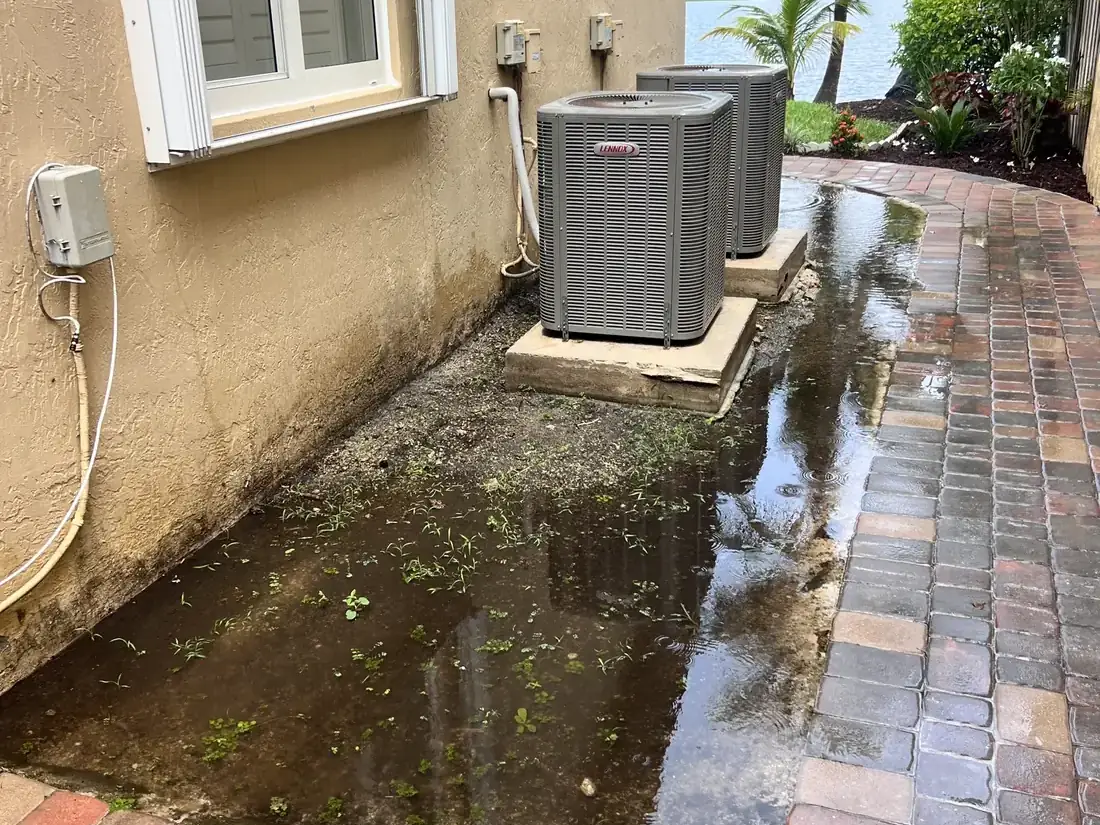
Most Cutler Bay yards flood for one of three reasons: the ground slopes toward the house, the water table is high, or the water has nowhere to go during a big storm. Regrading, swales and a French drain can solve the first and part of the third, but nothing in a yard can lower the water table. The first job is finding out which problem you have, and where the water can actually go.
Why does my yard flood in Cutler Bay?
The Town of Cutler Bay lists three flood sources on its Flood Awareness page: tidal flooding and storm surge during hurricanes and tropical storms, flash flooding when heavy rain overloads the drainage system, and flooding when canals and stream channels are pushed past capacity. The Town sits close to Biscayne Bay and the Atlantic Ocean, and the land is flat.
Underneath that flat ground is limestone. The U.S. Geological Survey describes the Biscayne aquifer as shallow, highly permeable limestone, and says the water table in it is commonly near the land surface in parts of Miami-Dade and may rise above the surface during wet periods. In plain terms: in the rainy season the ground can already be full, so a normal storm has nowhere to soak in. The National Weather Service generally puts the South Florida rainy season from mid-May to mid-October.
In early June 2022 the Town recorded 22.68 inches of rain in about a week, and neighborhoods including Saga Bay, parts of Lakes by the Bay and the area north of Franjo Park flooded badly. A Cutler Bay resident told CBS Miami at the time, "we've never had it this bad." Most yards will not see that. The same flat ground is why an ordinary afternoon storm can leave puddles for days.
"ever since they finished and put all the soil back into place, our yard floods like this every time it rains for more than 25 minutes." (a homeowner on Reddit, r/florida, 2024) And: "pumping water to the edge of my property does nothing - it'll just drain right back." (r/landscaping). Both describe the same two mistakes: soil put back without proper grading, and water moved to a place that cannot take it.
Is it surface water or groundwater?
The fix is different, so check first. Watch the yard during and after a rain. If water runs across the surface and collects in a low spot or against the house, it is a surface and grade problem, and that is usually fixable. If the ground stays soggy for days after the rain stops, or water seeps up from below, the water table is likely the cause.
- Surface water: puddles form quickly, drain slowly, and follow the shape of the yard.
- Groundwater: the whole yard is wet, even in spots that are not low, and it improves only as the rainy period passes.
- Roof water: a patch beside the house that gets worse right under a downspout or gutter outlet.
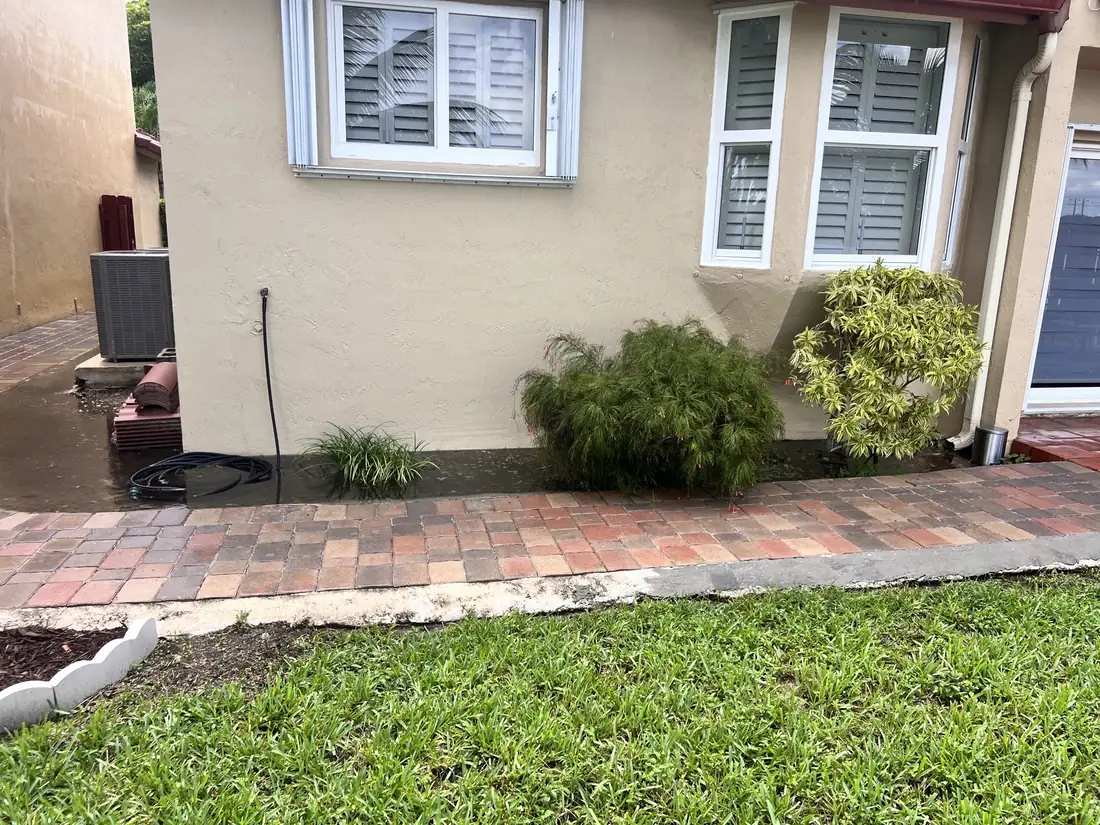
Many yards have more than one cause at once. We walk the yard, ideally after a rain, and look at the slope, the low spots, where roof water lands and where the neighbors' yards drain. Our grading and drainage page explains how that assessment works.
Is my yard in a flood zone, and does that change the fix?
It can change what you expect from any fix. FEMA flood maps are free to view at msc.fema.gov/portal, and the Town's Public Works Department makes free flood zone determinations for properties in the Town: call 305-234-4262. The Town also says it can give one-on-one advice to a property owner about flooding and drainage on private property.
Two cautions from the Town's own pages. Being outside a mapped flood hazard area does not mean a property is safe from flooding. And flooding is not covered by a standard homeowner's insurance policy, and flood insurance generally has a 30-day waiting period before it takes effect, so do not wait for the storm to look into it.
Which fix works for which problem?
| Fix | What it does | Works best when |
|---|---|---|
| Regrading and leveling | Reshapes the ground so water runs away from the house | Water pools against the foundation or in a low spot, and there is somewhere lower to send it |
| Swale | A shallow, planted channel that carries runoff across the yard | A larger yard with a clear low route to follow |
| Downspout extension | Moves roof water farther from the wall | The wet patch is right under a downspout |
| Rock drainage area | A stone bed that lets water pass and slows erosion | Outlets, wet strips along walls |
| Buried drain pipe or French drain | A perforated pipe in gravel that collects water and carries it to an outlet | There is an outlet lower than the wet spot and the soil can drain |
| Water-tolerant plants | Puts plants that handle wet soil in the wettest spot | A low area you cannot fully drain |
Our work centers on regrading, swales, rock areas and downspout solutions. A larger buried system can be the right answer on some properties, and when yours needs one, we tell you instead of selling a smaller fix that will not work. For wet spots you cannot fully drain, University of Florida guidance lists wax myrtle and buttonwood among natives that tolerate wet or periodically flooded soil; see our native planting page.
Why do French drains fail in South Florida?
"French drain" is what most people search for, and it is a good tool in the right place. It fails here for reasons that have nothing to do with the trench itself:
- No outlet. A French drain only moves water. If the pipe ends at the edge of a flat lot with nowhere lower to go, the water backs up and the drain fills. A homeowner on Reddit described exactly this: moving water to the property edge "does nothing."
- A high water table. In the wet season the trench can fill from below, and gravity will not empty it until the water table drops.
- Clogging. Fine sand, fabric and tree roots can clog a drain over time, so it needs a way to be inspected and cleaned.
- Wrong job. If the real problem is a yard that slopes toward the house, no trench will fix the grade.
That is why we start with the outlet and the elevations, not the trench. A shallow hole filled with gravel (a dry well) has the same limit: with a shallow water table, it can fill up instead of draining.
Where does the water go?
Every drainage plan answers this before anything is dug. The options are the street or swale, a canal, a neighbor's yard, or a dry well, and each has limits. The Town says the South Florida Water Management District maintains the main canals (C-100B and C-1N), and Miami-Dade County maintains the smaller channels and ditches, so a pipe that empties into a canal is not simple. The street and the swale in front of your house are public right-of-way, which brings us to the neighbor and permit questions.
Can I send water onto my neighbor or the street?
Treat it as no until you have checked. Changing a yard's grade can push water onto the next lot, and neighbors have complained about exactly that. A Palmetto Bay resident quoted in a community newspaper in 2018 described runoff crossing the road from a neighboring property, and the article said Miami-Dade code requires property owners to retain stormwater runoff on their own property. That was one resident's account in a news story, not a ruling, so confirm the current rules for your lot.
The Town's Stormwater Utility is the point of contact for drainage questions and concerns, and the Town's Code Enforcement handles construction without permits. Before we regrade, we look at where the water will end up, and we do not build a plan that sends the problem next door.
Do I need a permit to regrade, build a swale or add fill?
Ask before you start. The Town of Cutler Bay says to contact its Building Department before you begin any fill or construction: 305-234-4193. Miami-Dade County requires written permits for altering drainage ways such as ditches, drains and canals. We could not confirm from a County source whether an ordinary residential regrade needs its own permit, so we do not guess. If your project may need one, we will tell you, and the Building Department has the final word.
Who maintains the swale in front of my house?
You do. The Town's Public Works FAQ says the resident is responsible for maintaining the swale area next to their property, and that the Town does not re-sod it. Maintaining the swale is not the same as changing it: filling it in can push water into the street or onto a neighbor, and any tree in the swale is protected in many cases. Our tree permit guide covers who to call before you touch a swale tree.
What about HOA rules, easements and canal setbacks?
Many yards in Cutler Bay and Palmetto Bay sit under an HOA with architectural review, and some back onto canals with district easements. We did not find a single public source that covers every HOA rule, so check your HOA's guidelines before grading, adding walls or planting near a property line. The South Florida Water Management District also keeps right-of-way easements along some canals on private property, so a drain or swale near a canal needs an outlet plan that does not dump into the district canal.
How do tree roots, palms and fill affect drainage?
Roots can clog drain pipes, and piling fill or soil against a trunk can harm the tree. A good plan works around the trees you want to keep. If a tree has to come out to fix the grade, check the permit rules first, and see our tree trimming and removal page. Clearing overgrown ground before grading is covered on our land clearing page.
How do king tides and storms change the plan?
The king tide is the highest predicted high tide of the year, and in Southeast Florida these usually come in the fall. On the days around it, tidal water can rise on streets and in low yards even without rain. A yard drain cannot beat the tide, so the honest goal in low tidal areas is to protect the house and manage the yard, not to promise it will never get wet. We could not find a Cutler Bay or Palmetto Bay source tying king tides to yard flooding specifically, so treat this as general South Florida guidance.
What drives the cost of a drainage job?
Homeowners ask this first, and the answer is cost drivers, not a number, because every lot is different:
- How much soil has to move and how far.
- How far the water has to travel to a legal outlet, and how much lower the outlet is.
- Rock and limestone close to the surface, which slow digging.
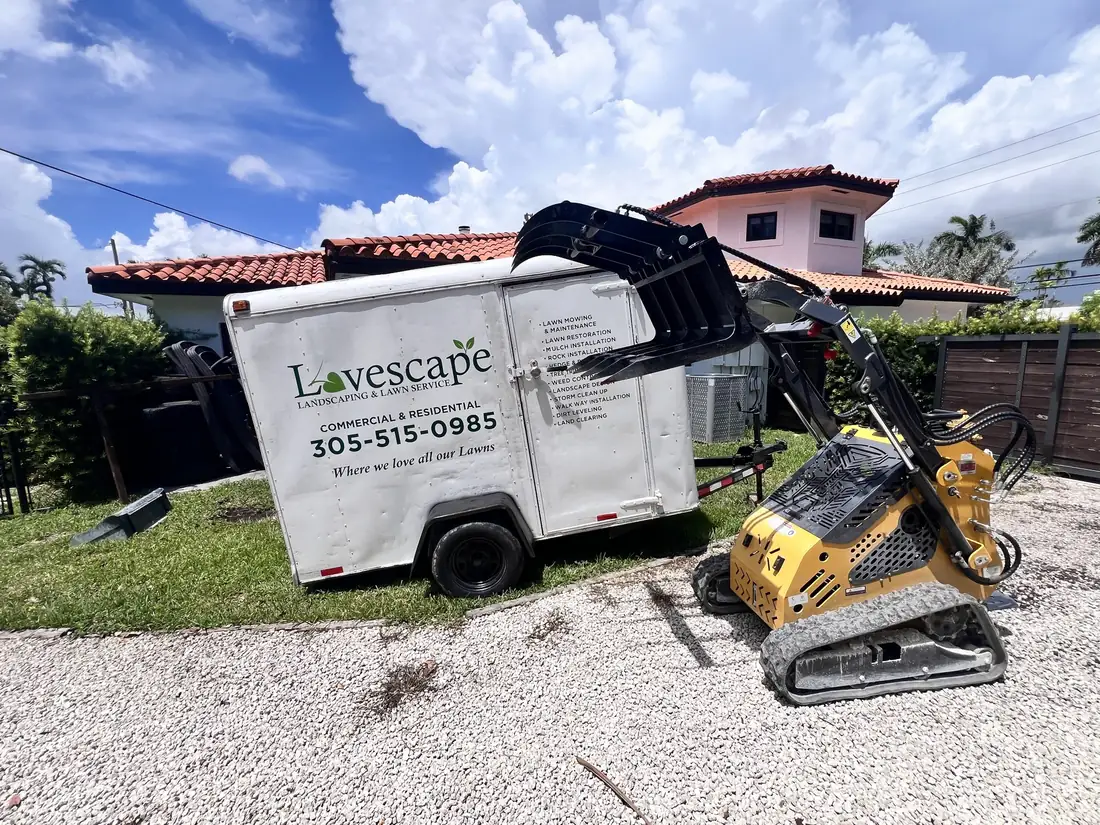
- Access for equipment. Our mini skid steer fits most side gates, which keeps the lawn intact.
- Trees, utilities and irrigation lines in the way.
- What has to be restored after: sod, rock or mulch.
We assess first and give a free, no-obligation estimate. See our skid steer services for the equipment side of the work.
How do I keep a drainage fix working?
- Walk the yard after the first big storms and note where water still sits.
- Keep swales mowed and clear of leaves and debris, and keep inlets and downspout outlets clear.
- Check downspout tie-ins and extensions for cracks or blockages.
- Do not pile mulch, soil or yard waste in a swale or against a wall.
Many drainage problems start as an outlet blocked by yard waste after a storm, so clear debris from inlets and swales as soon as it is safe.
How does a drainage job work with Lovescape?
Look at the yard
We walk it, ideally after a rain, and look at the slope, the low spots, roof water and the neighbors' drainage.
Plan where the water goes
We lay out a grading plan that moves water away from the house and toward a place it can actually go.
Grade and level
We do the dirt leveling and soil work, finish with rock, sod or plants where the plan calls for it, and haul the extra soil away.
Check it after rain
After the next significant rain, we look at how the yard is draining. A grading fix is only proven once the water has been tested.
For a plan that covers the whole yard, see custom landscape design, our landscaping overview, or contact us.
Questions homeowners ask
Usually the ground slopes toward the spot, roof water lands there, or the soil is saturated. Watch where it forms and how fast it drains to tell a grade problem from a water table problem.
It depends on the work and the location. The Town of Cutler Bay asks you to contact its Building Department before any fill or construction, and Miami-Dade requires permits for altering ditches, drains and canals. Check with them before you dig.
It depends on the length, depth, soil and rock, access, and how far the outlet is. We assess the yard first and give a free estimate, because the same trench can be simple on one lot and impossible on another.
It needs an outlet lower than the wet spot, it can fill from below when the water table is high, and fabric, sand and roots can clog it. In flat Cutler Bay, regrading or a swale is often the first fix to try.
That is a dry well, and it only works if the surrounding soil can take the water. With a shallow water table it can fill up and stay full in the rainy season.
The swale and street are public right-of-way, and the Town says residents maintain the swale. Changing it can push water to a neighbor or the street, so check with Town Public Works first at 305-234-4262.
Request a free estimate or call 305-515-0985.


 Get a Free Quote