

The Miami-Dade summer ban on nitrogen and phosphorus fertilizer runs May 15 through October 31, so from November 1 you can fertilize again, but the County's yearly limits still apply. Before you spread anything, check the bag, check the date and check whether your lawn really needs feeding.
When does the fertilizer ban start and end?
Miami-Dade County prohibits fertilizers containing nitrogen or phosphorus on turf and landscape plants from May 15 to October 31, to protect Biscayne Bay and the County's waterways. That covers homeowners and landscape crews alike. The ordinance has more detail than this page can hold, so use the County's fertilizer page as the final word, and check it each year in case dates or limits change.
Iron and other micronutrient products without nitrogen or phosphorus are generally treated as separate from the ban, but read the label and ask if you are unsure. This page was written from County information and general lawn guidance. Last checked November 2026.
What do the rules still limit after the ban ends?
The ban lifting does not mean "anything goes." The ordinance also sets limits that apply all year. As we understand them, they are:
| Rule | What it says |
|---|---|
| Yearly nitrogen | Up to 4 lb of nitrogen per 1,000 square feet per year |
| Per application | Up to 1 lb of nitrogen per 1,000 square feet for a solid fertilizer, and 0.5 lb for a liquid |
| Slow release | Granular fertilizer should be at least 65 percent slow-release nitrogen |
| Near water | No fertilizer within 20 feet of a lake, canal or other water body |
| New sod | None for 60 days after the lawn is sodded |
| Phosphorus | Only when a soil test shows the lawn needs it |
Those numbers match the County ordinance as we last read it. If a bag says "winterizer" or "weed and feed," look at the three numbers on the front (nitrogen, phosphorus, potassium). A middle number above zero means phosphorus, which you should skip unless a soil test says otherwise.
If your yard backs onto a lake or canal, as many do in Cutler Bay and Palmetto Bay, the 20-foot buffer matters. Sweep granules off the sidewalk and driveway so they do not wash into the storm drain.
Does your lawn actually need fertilizer right now?
Not always. A lawn that is yellow in November might be short on iron, short on water, stressed by shade, or infested with pests. Feeding the wrong problem wastes product and can push extra nutrients into the water.
- Look at the pattern. Uniform pale color across the lawn points to nutrients. Irregular brown or yellow patches point to pests, disease or drainage.
- Check for insects before you feed. Our lawn restoration page explains how to tell damage from stress.
- Look at the soil. Miami-Dade soil is alkaline limestone with a pH commonly around 7.8 to 8.4, which can lock up iron and other micronutrients and make a healthy-looking lawn turn pale.
- Consider a soil test through UF/IFAS Miami-Dade Extension before changing your program.
What kind of product makes sense under the rules?
For most St. Augustine lawns here, the safe approach is a slow-release fertilizer that fits the 65 percent rule, applied at a rate that keeps the whole year under 4 lb of nitrogen per 1,000 square feet. Count every application, including anything a previous contractor put down. Many homeowners do not realize that two or three bags a year can already hit the cap.
If the lawn is pale but not thin, a micronutrient product without nitrogen may be what it needs. We will not claim a product fixes a problem we have not seen, so we would look at the yard first.
What should you do besides fertilizing?
Mowing height and watering usually matter more than another bag of fertilizer. For St. Augustine, UF/IFAS recommends about 3.5 to 4 inches for standard varieties, and never removing more than a third of the blade at a time. Our lawn mowing and maintenance page covers the routine.
For watering, Miami-Dade day-of-week rules generally limit sprinklers to two days a week, before 10 a.m. or after 4 p.m.: odd addresses on Wednesday and Saturday, even addresses on Thursday and Sunday. A new lawn can be watered more often for its first 90 days. Always check for a current South Florida Water Management District order, because drought conditions can change the schedule.
Check the date
It must be on or after November 1 for any nitrogen or phosphorus product.
Read the bag
Look at nitrogen, phosphorus and the slow-release percentage.
Add up the year
Keep the total under 4 lb of nitrogen per 1,000 square feet.
Protect the water
Stay 20 feet from water and sweep hard surfaces clean.
What about weeds and bare spots in the cooler months?
Weeds do not stop growing when the ban ends, and fall is a good time to deal with them before they set seed. Our weed control page explains what we can treat and what only a lawn renovation fixes. If a lawn is more than half weeds or bare, new sod may be the honest answer; see our lawn restoration and mulch installation pages for the next steps in your beds.
For the bigger picture, see our full lawn care service or contact us to have someone look at your yard.
Does the same advice apply to palms, shrubs and beds?
The ordinance covers turf and landscape plants, so the summer ban applies to shrubs, hedges and palms as well as grass. Palms in particular often look yellow because of a nutrient problem tied to alkaline soil rather than a lack of general fertilizer, and cutting off green fronds does not fix it. Our tree trimming page explains why we remove only dead fronds, and our hedge and bush trimming page covers hedges that look pale after a hard summer.
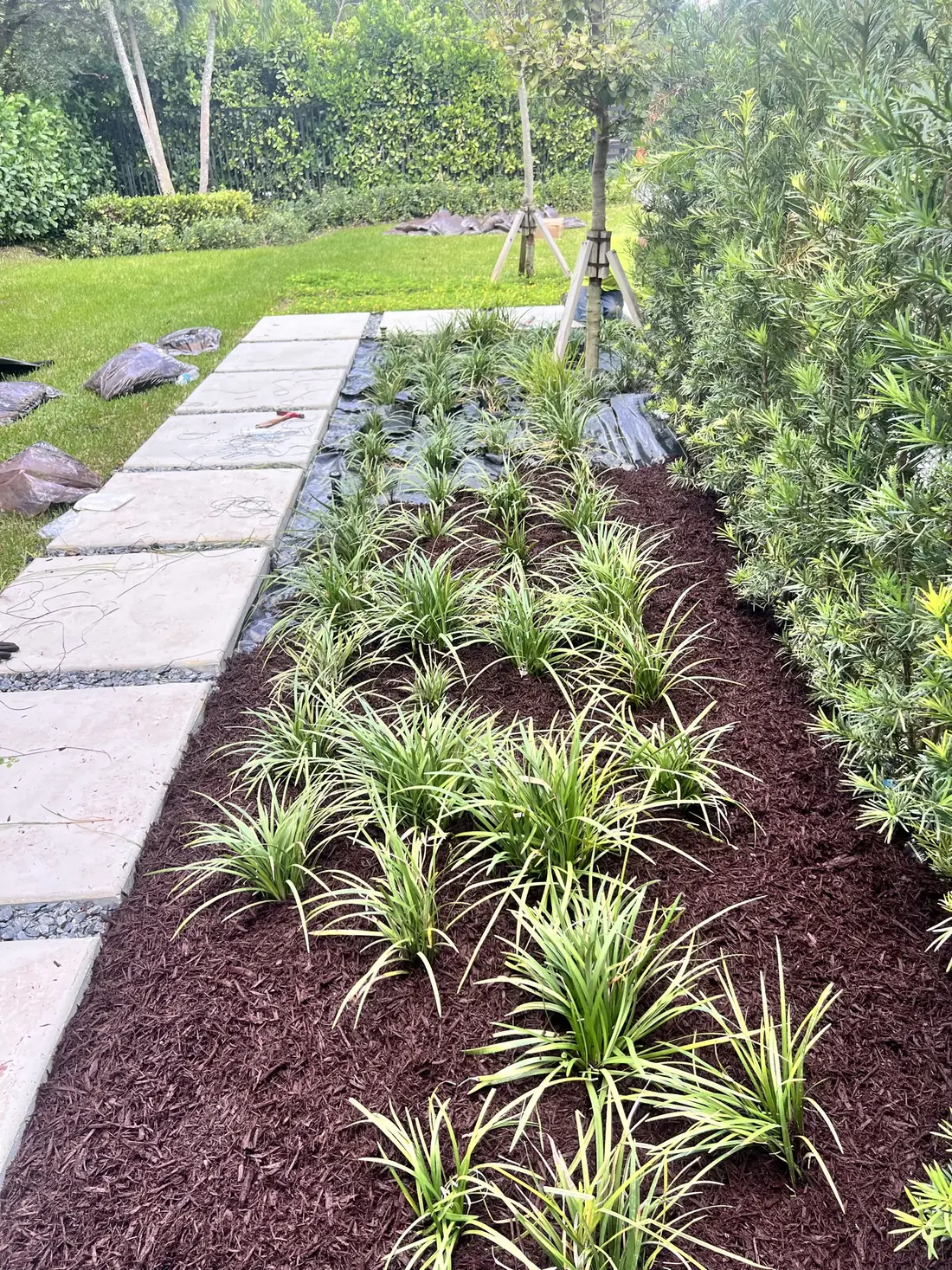
Mulch helps too. A layer 2 to 3 inches deep, kept about a foot from large trunks, holds moisture and slowly feeds the soil as it breaks down. See mulch installation for how we do it, and native planting if you want plants that need less feeding to begin with. Palmetto Bay and canal-side yards should read our Palmetto Bay page for how the water buffer applies there.
Questions homeowners ask
Under the County rule, yes, the summer ban ends October 31. You still have to stay within the yearly limits and the 20-foot water buffer.
It is covered by the same rules as any fertilizer because it contains nitrogen, so it cannot be used during the ban. Outside the ban it is allowed if it fits the limits, but many of these products contain more than the label suggests, so read it closely.
Iron products without nitrogen or phosphorus are generally treated as separate from the ban. Check the label, and ask the County if the product is unclear.
The County sets a cap of 4 lb of nitrogen per 1,000 square feet per year, with 1 lb as the most per solid application. Count all applications, including those from other contractors.
The ordinance says no fertilizer for 60 days after sodding. Water it on the schedule for new landscaping and wait.
Ask us what is included for your yard and we will tell you plainly. Any application we make follows the County ordinance.
Request a free estimate or call 305-515-0985.


 Get a Free Quote